
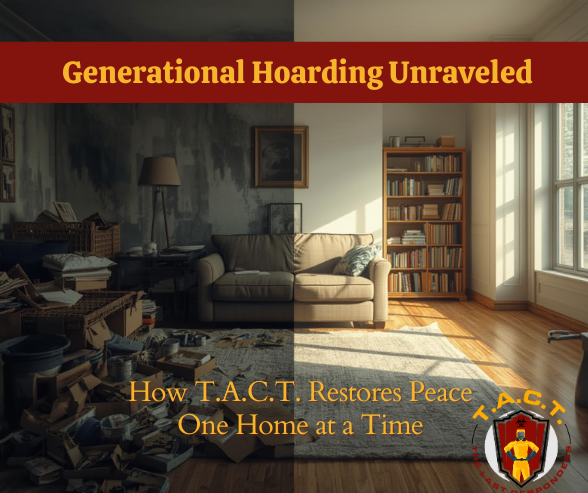
Breaking the Cycle: Understanding Generational Hoarding
Hoarding is often misunderstood as a simple issue of clutter or disorganization. In reality, it can be deeply rooted in family history and lived experience. For many individuals, hoarding behaviors don’t begin in adulthood—they begin in childhood.
Growing Up in a Hoarded Home
When a child grows up in a home affected by hoarding, the emotional impact can be profound. These children often experience feelings of isolation and shame. They may avoid inviting friends over, worry constantly about judgment, or feel different from their peers. Over time, this can normalize the environment they are living in, even if it feels overwhelming or unsafe.
What starts as a coping mechanism—holding onto items for comfort, security, or control—can quietly carry into adulthood.
When the Pattern Repeats
As these children grow up and establish homes of their own, they may find themselves repeating the same behaviors they witnessed. This is sometimes referred to as generational hoarding. Without realizing it, individuals can recreate familiar patterns, even when those patterns cause stress, strained relationships, or health and safety concerns.
It’s important to understand: this cycle is not caused by laziness or a lack of willpower. Hoarding is complex, emotional, and often tied to past experiences.
Decluttering as a Reset
At T.A.C.T. Fort Worth, we want to be clear—our employees are not therapists. However, we have seen firsthand how the process of decluttering and cleaning can provide a powerful reset for individuals and families.
Removing excess belongings, restoring safe living conditions, and reclaiming usable space can help people:
- Feel less overwhelmed
- Regain a sense of control over their environment
- Create space for healthier routines and relationships
For many, this physical change becomes the first step toward emotional relief and forward momentum.
A Judgment-Free Approach
We approach every hoarding situation with discretion, compassion, and respect. We understand that behind every home is a story. Our role is not to judge the past, but to help create a safer, healthier space for the future.
If you or someone you love is struggling with hoarding, know that help is available—and change is possible.
Contact T.A.C.T. Fort Worth
T.A.C.T. Fort Worth is here to help you take that first step. For more information on our professional services, contact us today at 817-774-4715.
Serving the North Texas Community
T.A.C.T. Fort Worth is ready to assist in Arlington, Benbrook, Dallas, Decatur, Denton, Fort Worth, Grapevine, Haslet, Irving, Keller, Lake Worth, North Richland Hills, Plano, Richardson, Saginaw, Springtown, White Settlement, and surrounding areas.